
Frameworks for Agentic AI: A Deep Dive
Comparing LangGraph, AutoGen, CrewAI, and Smol Agents


Overview:
Artificial Intelligence (AI) has rapidly evolved, offering tools and frameworks that simplify and accelerate the development process. Among the most exciting developments in AI tooling are Lang Graph, Autogen, CrewAI and SmolAgents. These tools empower developers and researchers by streamlining workflows, enhancing creativity, and enabling rapid prototyping of AI-powered solutions. In this blog, we’ll dive deep into these frameworks, exploring their unique features, benefits, and how they fit into the broader AI ecosystem.
LangGraph

LangGraph is a library developed by Lang Chain Inc for building stateful, multi-actor applications with LLMs, used to create agent and multi-agent workflows.
It seamlessly integrates with Lang Chain and Lang smith and also offers no-code studio.
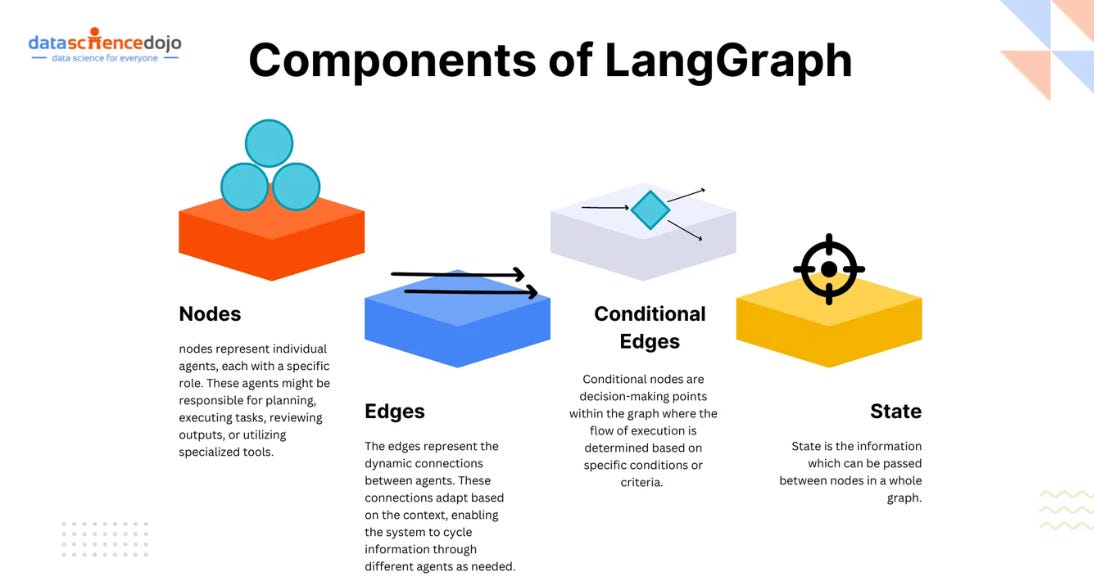
Key Components of LangGraph Source
Features:
Graph-Based Interaction Modeling – Represents agent interactions using a structured graph approach.
Robust Error Handling – Includes built-in mechanisms for error detection, retries, and recovery.
Customizable Architecture – Supports tailored node and edge implementations to fit diverse workflows.
Advanced Planning & Reflection – Enables strategic decision-making and adaptive learning.
Stateful Workflows – Maintains memory and context across interactions for seamless task execution.
Multi-Agent Collaboration – Facilitates coordination and communication between agents.
Seamless Lang Chain Integration – Works effortlessly with Lang Chain’s tools and components.
Human-in-the-Loop Support – Allows human oversight for review, intervention, and approval
Applications:
AI-Powered Assistants with Multi-Agent Collaboration
LangGraph enables sophisticated AI assistants that coordinate multiple agents to handle complex tasks. For example, a customer support chatbot where:
One agent retrieves customer data.
Another analyzes the issue.
A third suggests possible solutions.
Automated Decision-Making Systems
Ideal for AI-driven decision-making processes that require evaluating multiple conditions and dynamic inputs, such as:
Financial Risk Assessment – Evaluates loan applications or fraud detection.
Legal Document Review – Automates contract analysis and compliance checks.
Medical Diagnosis Assistance – Supports doctors in identifying potential conditions.
Advanced Conversational AI
Unlike basic chatbots, LangGraph supports context-aware, multi-turn conversations, making it ideal for:
AI-powered interview and assessment systems.
Educational tutoring assistants.
HR recruitment bots that screen candidates.
Enterprise Workflow Automation
Businesses can streamline internal operations with LangGraph, automating:
Document Approval Chains – Routing contracts and forms for review.
Data Aggregation – Collecting insights from multiple sources.
IT Support Ticket Resolution – Automating troubleshooting and escalation.
Research & Data Processing Pipelines
LangGraph orchestrates complex data workflows, making it useful for:
Automated Data Collection & Summarization – Extracting key insights from vast datasets.
Scientific Literature Review – Compiling research findings efficiently.
Market Trend Analysis – Monitoring real-time data for business insights.
Pros:
Graph-Based Flexibility – Supports dynamic, non-linear workflows instead of rigid sequential pipelines.
Scalability – Efficiently manages multiple AI agents and parallel execution.
Advanced State Management – Retains long-term context for complex workflows.
Multi-Agent Collaboration – Facilitates sophisticated reasoning and decision-making among agents.
Improved Debugging & Error Handling – Provides visibility into workflow execution for easier troubleshooting.
Seamless LangChain Integration – Natively connects with LLMs, APIs, and vector stores.
Cons:
Steep Learning Curve – Requires familiarity with graph structures and state management concepts.
Complex Debugging in Large Workflows – Deeply nested logic can be difficult to trace, even with debugging tools.
Requires Proper Agent Coordination – Poorly designed interactions may cause inefficiencies or logical loops.
Dependency on LangChain – Any limitations in LangChain also affect LangGraph.
Our experience working with LangGraph :
LangGraph excels at managing stateful workflows, making it ideal for applications that require maintaining context across multiple steps or interactions. This is particularly useful for long-running processes or systems with interdependent tasks.
One of LangGraph's standout features is its ability to integrate human decision-making into workflows. This allows workflows to pause and hand control to a human operator when necessary, ensuring critical decisions are made with oversight.
LangGraph’s modular architecture allows developers to integrate components from other frameworks like LangChain, LlamaIndex, or custom tools seamlessly. This makes it highly adaptable to diverse use cases.
LangGraph is designed to handle large-scale systems with dozens of microservices and real-time data pipelines. Its robust architecture ensures reliability even in high-demand environments.
LangGraph provides an orchestrator which can manage all other agents, tools and components when needed to invoke in workflow.
Shortcomings:
LangGraph has a steeper learning curve compared to lighter frameworks like SmolAgent or CrewAI. It requires a deeper understanding of state management and workflow design, which can be challenging for beginners.
Unlike some other frameworks, LangGraph does not offer built-in retrieval-augmented generation (RAG) or evaluation tools. Developers need to integrate these functionalities from external libraries.
LangGraph is primarily code-driven, with no GUI or no-code studio for workflow creation. This can be a barrier for non-technical users or rapid prototyping.
References:
Autogen:

AutoGen is a framework developed by Microsoft for creating multi-agent AI applications that can act autonomously or work alongside humans.
Features:
Multi-Agent Orchestration
AutoGen’s core capability is managing multiple AI agents that:
Engage in complex, dynamic conversations.
Delegate tasks based on specialized roles.
Collaborate to solve intricate problems.
Self-improve through automated feedback loops.
Flexible Configuration
The framework allows extensive customization, including:
Defining agent roles and behaviors.
Configuring conversation flows and memory management.
Implementing error handling and recovery strategies.
Seamlessly integrating with external tools and APIs.
Advanced Programming Capabilities
AutoGen agents are highly effective for coding-related tasks such as:
Code Generation & Debugging – Automates development workflows.
Test Case Creation – Generates and validates test scenarios.
Code Optimization – Enhances performance and efficiency.
Documentation Generation – Produces structured and detailed documentation.
Real-Time Error Correction – Detects and fixes issues as they arise.
No-Code Studio
A user-friendly GUI for building multi-agent applications without programming.
AutoGen Bench
A built-in benchmarking suite to evaluate agent performance and effectiveness.
Applications:
AI-Powered Software Development
Automates code generation, debugging, and optimization.
AI agents collaborate as a coder, reviewer, and debugger to enhance software quality.
Ideal for automated script generation and bug fixing.
Autonomous Research & Data Analysis
Collects, analyzes, and summarizes large datasets for market research, scientific studies, and financial modeling.
AI agents execute Python scripts for statistical and data-driven insights.
AI-Driven Decision Support Systems
Automates complex decision-making by analyzing multiple data sources and running simulations.
Acts as an AI consultant for finance, healthcare, and supply chain management.
Multi-Agent AI Assistants
Builds specialized AI assistants for various business operations.
Enables agents to collaborate, such as a support agent working with a sales agent to provide customer solutions.
Business Process Automation
Automates repetitive workflows like email handling, document generation, and scheduling.
Increases operational efficiency while reducing manual effort.
AI-Augmented Creativity & Content Generation
Assists in writing articles, generating ideas, and refining content.
Ideal for marketing copy, social media content, and creative projects.
Enhanced Productivity
Speeds up development time with automated workflows.
Handles routine tasks, freeing up developers for strategic work.
Improves code quality and consistency with AI-driven checks.
Enables faster problem-solving through collaborative agents.
Flexibility and Scalability
Easily integrates with existing systems and workflows.
Supports customizable agent behaviors for tailored solutions.
Scalable architecture to handle increasing workloads.
Works across multiple platforms and environments.
Cost-Effectiveness
Lowers development and maintenance costs.
Optimizes resource utilization for efficiency.
Reduces reliance on human intervention, improving ROI.
Innovation Potential
Enhances problem-solving with multi-agent collaboration.
Adopts novel approaches to complex challenges.
Facilitates continuous learning and self-improvement.
Sparks creativity in AI-assisted solutions.
Pros
Enhanced Productivity
Speeds up development time with automated workflows.
Handles routine tasks, freeing up developers for strategic work.
Improves code quality and consistency with AI-driven checks.
Enables faster problem-solving through collaborative agents.
Flexibility and Scalability
Easily integrates with existing systems and workflows.
Supports customizable agent behaviors for tailored solutions.
Scalable architecture to handle increasing workloads.
Works across multiple platforms and environments.
Cost-Effectiveness
Lowers development and maintenance costs.
Optimizes resource utilization for efficiency.
Reduces reliance on human intervention, improving ROI.
Innovation Potential
Enhances problem-solving with multi-agent collaboration.
Adopts novel approaches to complex challenges.
Facilitates continuous learning and self-improvement.
Sparks creativity in AI-assisted solutions.
Cons
Technical Complexities
Steep learning curve for beginners.
Requires detailed configuration for optimal performance.
Integration with legacy systems can be challenging.
Needs performance tuning for efficiency.
Resource Requirements
Demands high computational power for multiple agents.
Consumes significant memory, especially in large-scale deployments.
Cloud infrastructure costs may be high for extensive use.
Initial setup and training require time investment.
AI Limitations
Dependent on LLM capabilities and potential biases.
Prone to hallucinations or factual errors.
Limited by context window constraints in conversations.
Requires human oversight to ensure reliability.
Security Considerations
Data privacy is a concern when handling sensitive information.
Potential security vulnerabilities in AI-driven decisions.
Access control challenges in multi-agent environments.
Must comply with regulatory and compliance standards.
Our experience working with Autogen:
AutoGen’s core strength lies in its ability to facilitate multi-agent conversations. Agents can collaborate, debate, and solve problems together, making it ideal for complex decision-making scenarios.
AutoGen allows developers to define agents with specific roles, capabilities, and behaviors. This flexibility enables the creation of highly specialized agents tailored to specific tasks.
Similar to LangGraph, AutoGen supports human-in-the-loop workflows, allowing human operators to intervene and guide agent interactions when necessary.
AutoGen integrates well with external tools and libraries, including LangChain and Hugging Face. This makes it easy to extend agent capabilities with additional functionalities.
AutoGen is designed to handle large-scale systems, making it suitable for enterprise applications. Its architecture supports distributed computing, enabling efficient resource utilization.
AutoGen provides a group chat orchestrator who manages all agents, and we can select the next speaker in multiple ways (custom function, Round Robbin fashion).
Shortcomings:
Configuring and managing multi-agent systems in AutoGen can be complex, especially for beginners. The framework requires a solid understanding of agent design and interaction patterns.
AutoGen lacks some built-in features like RAG. Developers often need to rely on external libraries for these functionalities.
Debugging multi-agent conversations can be challenging due to the dynamic nature of interactions. While AutoGen provides logging capabilities, visualizing and troubleshooting workflows can be time-consuming.
Unlike SmolAgent, AutoGen does not provide native sandboxing for code execution. This can raise security concerns when running untrusted code.
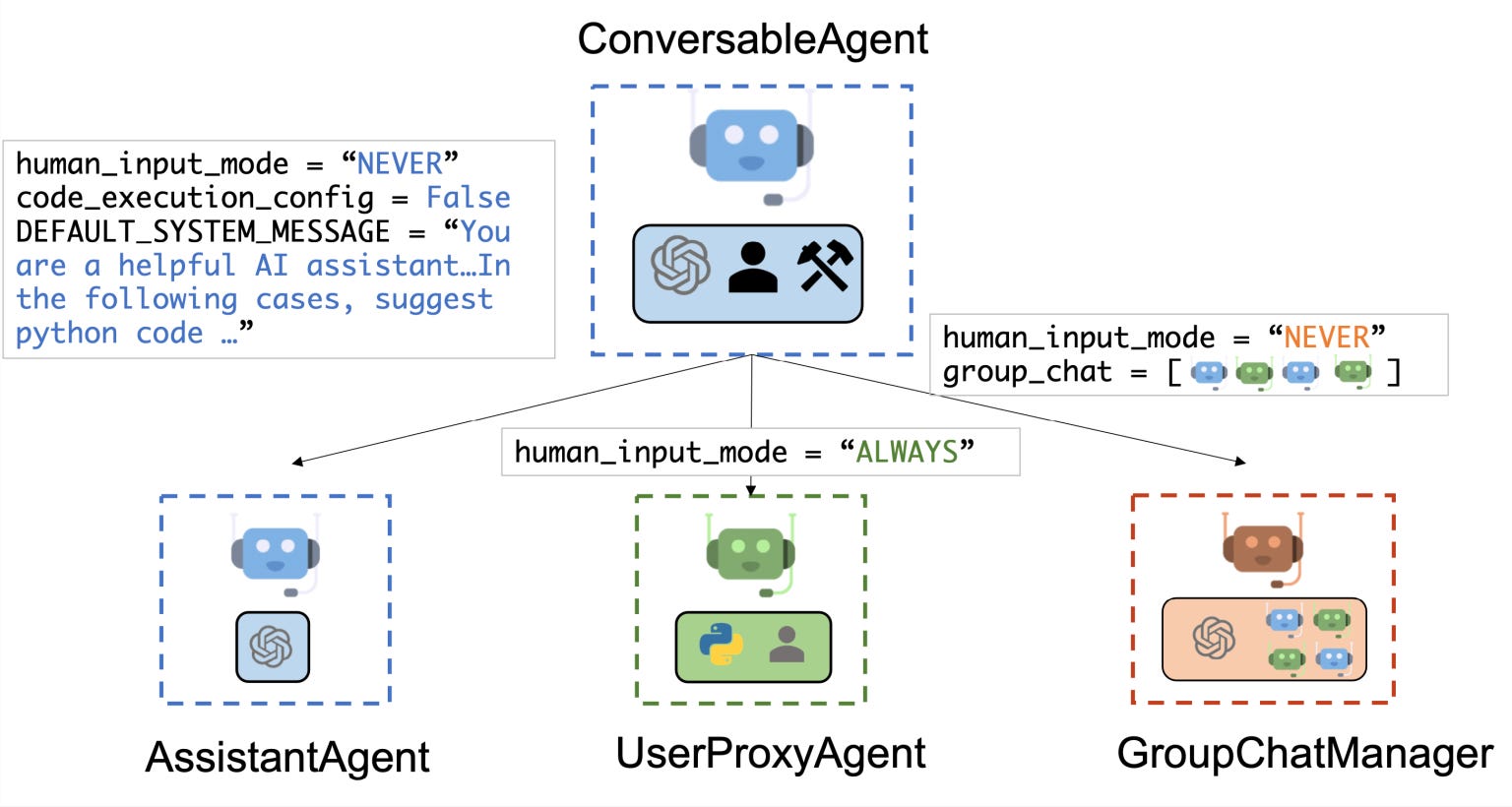
Conversation Flow source
References:
SmolAgents:

SmolAgents is a library that enables you to run powerful agents in a few lines of code.
This writes its action in code and also supports executing in sandboxed environments.
Features:
Minimalist Design
Optimized for low resource consumption with a small, efficient codebase.
Free from bloated dependencies or unnecessary functionalities.
Task-Specific Functionality
Designed for targeted, high-performance execution of specific tasks.
Avoids unnecessary generalization that adds complexity.
Low Latency and Fast Execution
Processes tasks with minimal computational overhead.
Optimized for real-time or near-instant execution.
Modularity and Composability
Easily integrates with other agents or software components to expand capabilities.
Enables seamless integration into existing workflows without major modifications.
Lightweight & Self-Sufficient
Functions without heavy API dependencies or third-party services.
Ideal for offline use or resource-constrained environments.
Open-Source and Customizable
Many Smol Agents are open source, allowing easy modification and extension.
Users can tailor agents to meet specific needs and preferences.
Applications:
Automated Content Generation
Generates short-form content, code snippets, and summaries.
Ideal for minimal, text-based AI interactions.
Code Automation & Debugging
Assists in generating, refactoring, and debugging small scripts.
Works efficiently in lightweight development environments.
Data Extraction & Processing
Scrapes and processes structured data without relying on heavy web crawling frameworks.
Helps filter and categorize information efficiently.
Chatbots and Assistants
Powers lightweight conversational agents for predefined tasks.
Well-suited for customer service bots with simple, task-specific use cases.
Workflow Automation
Automates repetitive tasks like scheduling reminders and handling notifications.
Can be integrated into CI/CD pipelines for basic automation.
IoT and Embedded Systems
Optimized for low-power, edge computing environments.
Provides smart functionalities with minimal hardware requirements.
Pros:
Lightweight & Efficient – Runs smoothly even on low-end devices.
Faster Execution – Minimal latency due to reduced computational demand.
Easy deployment & Maintenance – No complex setup or heavy dependencies required.
Enhanced Security – Fewer components mean fewer vulnerabilities.
Cost-Effective – Eliminates reliance on expensive API calls or cloud computing.
Modular & Customizable – Easily extendable for different tasks and workflows.
Cons:
Limited Functionality – Not suitable for complex, multi-purpose AI applications.
Less Scalable– May struggle with large-scale tasks requiring advanced learning models.
Reduced Flexibility – Optimized for specific tasks, making generalization difficult.
Requires Manual Fine-Tuning – Some use cases need careful customization.
Not Ideal for Heavy ML Tasks – Lacks support for deep learning and large-scale data processing.
Our experience working with SmolAgent:
Lightweight and very easy to learn. No steep learning graph like LangGraph . More suitable for quick POCs. Not apt for large scale enterprise systems where there are dozens of microservices and real-time data pipelines.
CodeAgents are its primary type of agent which produces python code instead of JSON or text in most of other agents. One of the research papers mentioned that producing code is better for agents. Paper Link. Code agents reduce the number of required actions, simplifying complex operations. Smolagents also supports toolcalling agent which writes tool calls in Json.
Tools have a tight integration with Hugging face and lang chain ecosystem. So, we can import any tool from Hugging face hub, HF Spaces and langchain.
Telemetry- They embrace the open telemetry standard for instrumenting agent runs which allows inspection and logging. It is also integrated with langfuse . This feature helps in logging and debugging of agentic systems. They also provide 1 utility to visualize agent workflow.
Retrieval agent or Agentic RAG – it allows query reformulation, multi-source like web search and local documents, results can be validated for relevance and accuracy before response generation.
Code security- Since code agent involves running code on the machine, it could compromise security and may have unintended consequences .SmolAgent tackles it by providing option to run code on sandbox envs and you need to explicitly mention dependencies agent can use.
Shortcomings:
NO GUI or no-code studio like environment which is offered by most of the other frameworks.
It is not a complete toolkit e.g. like llamaindex . If you are building rag agent or agent workflow, you will have to integrate components from different places e.g. indexer from llamaindex , tools from langchain etc.
There is no inbuilt evaluation like in llamaindex . You have to use an external evaluation library.
There is no human in the loop feature like in langraph or other frameworks where workflow can halt and give control to Human to take decision.
One of the issues in agents is LLM hitting the rate limit. No feature to load balance or tackle this issue.
How code agent works:
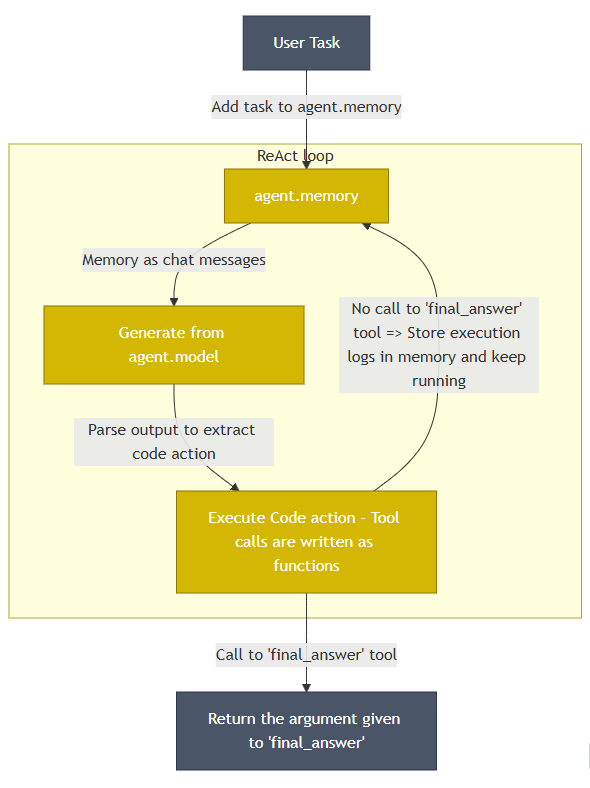
Source: smolagent github
References:
Crew AI:
CrewAI is an open-source framework that allows users to build autonomous AI agents capable of working in groups. Each agent is assigned a specific role (e.g., researcher, writer, analyst), and together, they decompose tasks, share context, and deliver outcomes faster and more efficiently.
Features:
Role-Based AI Agents
AI agents are designed for specialized roles—such as data analyst, project manager, or content creator—to replicate human expertise.
Example: A "Researcher" agent gathers relevant data from the web, while a "Writer" agent synthesizes the findings into a comprehensive report.
Autonomous Collaboration
Agents interact, delegate tasks, and share context to efficiently solve problems together.
Supports asynchronous workflows for continuous 24/7 task execution.
Task Decomposition
Complex tasks are broken down into smaller, manageable subtasks, which are intelligently assigned to specialized agents.
Seamless Integration with External Tools
Connects effortlessly with APIs, databases, and platforms like LangChain, AWS, and custom scripts to enhance functionality.
Human-in-the-Loop (HITL) Oversight
Enables human intervention to review, approve, or refine AI-generated outputs for greater accuracy and control.
Context Preservation
Agents retain memory of previous interactions, ensuring continuity and consistency in long-term projects.
Scalability
Scale effortlessly from a handful of agents for small tasks to hundreds for enterprise-grade workflows.
Applications:
Business Process Automation
Use Case: Automate customer support by enabling AI agents to handle inquiries, escalate issues, and update CRM systems.
Impact: Reduces response time by 70% and cuts operational costs by 50%.
Content Creation & Marketing
Use Case: Deploy AI-driven writers, editors, and SEO analysts to generate blog posts, social media content, and ad copies.
Impact: Produces high-quality content at scale while maintaining brand consistency.
Data Analysis & Decision-Making
Use Case: Leverage AI analysts to process large datasets, extract insights, and generate actionable reports for stakeholders.
Impact: Speeds up data-driven decision-making across industries like finance and healthcare.
Software Development
Use Case: AI-powered developers, testers, and DevOps agents collaborate to code, debug, and deploy applications.
Impact: Accelerates development cycles and enhances code quality.
Healthcare Diagnostics
Use Case: Medical AI agents analyze patient data, cross-reference research, and recommend treatment plans.
Impact: Improves diagnostic accuracy and reduces physician workload.
Pros:
Enhanced Efficiency
Completes tasks faster than human teams or standalone AI models.
Cost Savings
Lowers labor costs and reduces operational overhead.
24/7 Productivity
Works continuously without fatigue or downtime.
Customizability
Adaptable to specific roles, industries, and workflows.
Error Reduction
Minimizes mistakes in repetitive or data-intensive tasks.
Scalable Innovation
Empowers small businesses with enterprise-grade AI capabilities.
Cons:
Complex Setup
Requires technical expertise to configure and integrate AI agents.
Data Privacy Risks
Handling sensitive data may pose compliance challenges (e.g., GDPR).
Dependency on Quality Data
Poor or biased data can lead to unreliable outputs.
Ethical Concerns
Increased automation may contribute to job displacement.
Resource Intensive
Large-scale deployments demand significant computational power.
Lack of Emotional Intelligence
Not suitable for tasks requiring empathy or human judgment.
Our experience working with CrewAI:
Easy to use. Its role-based agent philosophy is very easy to configure. They offer config-based project initialization mode for enterprise deployment, SDK and CLI for quick tests.
Training feature: This is a very unique feature in which you can take any of your agents and can train using CLI. It required feedback on each iteration.
Flows – It is another feature of CrewAI which lets you create structured, event-driven workflows. It simplifies workflow creation, state management of different tasks and allows easy conditional logic, loops and branching within the workflows.
Knowledge source – inbuilt functionality of CrewAI which lets you use text, csv, Json documents. It is like inbuilt RAG for Agents, and you just need to configure a few things like chunking and embeddings.
Planning: when enabled, this sends whole crew (all agents) information to inbuilt Agent planner that plans task step by step and this plan gets added to each task description.
Testing: It uses LLM as a judge in built evaluation. It allows us to give number of iterations, model as params during testing.
Memory: Its memory system is very comprehensive. It supports following types of memories:
Short-Term Memory: stores recent interactions temporarily. This is used in the current context.
Long-Term Memory: Valuable insights and learnings from past executions.
Entity Memory: Captures information about entities (People, Place, Concepts etc.). Useful for relationship mapping.
Contextual memory: Maintain context of interactions by combining short term, long term and entity memory.
User Memory: Stores user specific information and preferences for personalization and user experiences.
Memory is stored in SQLLITE D/B.
Tasks: Supports 2 types of tasks. Sequential (executes them in order they are defined), Hierarchical (assigned based on agent’s roles and expertise).
Shortcomings:
Limited customizations and control because of its predefined roles and responsibility design. Not apt for very open-ended problems.
No built-in secure code execution capabilities.
Hard to debug because of coordination and communication overhead. Debugging becomes difficult as system scales.
Crew vs Flows:
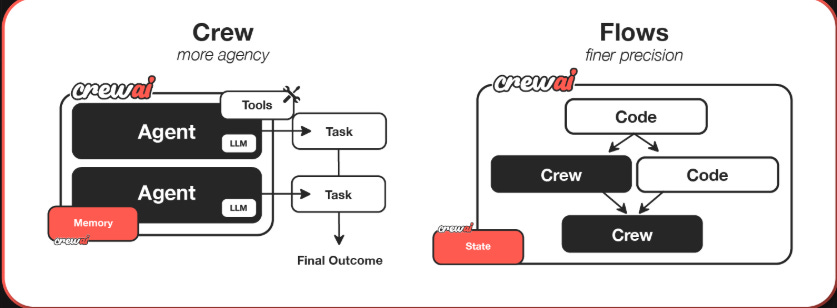
Source: crewai docs
References:
Comparison:
 |
|